
Dish soap does not automatically ruin granite. The Natural Stone Institute allows mild liquid dishwashing detergent for stone care and warns that too much cleaner can leave film or streaks. The original question is worth keeping, but the answer needs a rinse check before a restoration sales pitch.
The missing part of the dish-soap advice is the rinse
A plate usually gets a full rinse; a kitchen counter often gets one wipe with a damp cloth. That difference matters. Detergent left behind after a cleaning pass can make the surface appear streaked. It does not prove that the stone has lost its polish or that an impregnating sealer has been stripped. First establish whether the mark is removable.
What water-hardness data actually tells you
| Hardness as calcium carbonate | Classification | What it does not tell you |
|---|---|---|
| 0 to 60 mg/L | Soft | The hardness at a particular East Valley address. |
| 61 to 120 mg/L | Moderately hard | How much detergent you should add. |
| 121 to 180 mg/L | Hard | Whether a cloudy spot is mineral buildup or a damaged finish. |
| More than 180 mg/L | Very hard | Whether a countertop needs polishing. |
These are USGS classification thresholds, not a Gilbert, Chandler or Mesa tap-water measurement. A home with a softener can differ from its municipal supply. Use a current utility report or a sample measurement rather than assigning one hardness number to every East Valley kitchen. White deposits near a faucet can be consistent with minerals, but their appearance alone does not identify the chemistry.
Detergent film is not automatically traditional soap scum
Modern dish detergents use surfactant formulations that differ from traditional fatty-acid soaps. Do not assume every dish liquid produces the same calcium-soap deposits. Fragrance, additives, dose, water and rinse habits vary. We also cannot infer that a named Dawn formulation strips every stone sealer. Choose mild, material-compatible products and follow the stone and sealer instructions.
Compare four observations before booking polishing
| Observation | Possible explanation | Next step |
|---|---|---|
| Streak moves or diminishes after a clean-water rinse | Removable cleaner residue | Adjust dilution and rinsing; dry and recheck. |
| Crust is concentrated around the faucet | Mineral or mixed deposit | Use a stone-compatible deposit assessment, not vinegar. |
| A darker mark remains below a clean dry surface | Possible absorbed staining | Ask about stain diagnosis and a suitable poultice. |
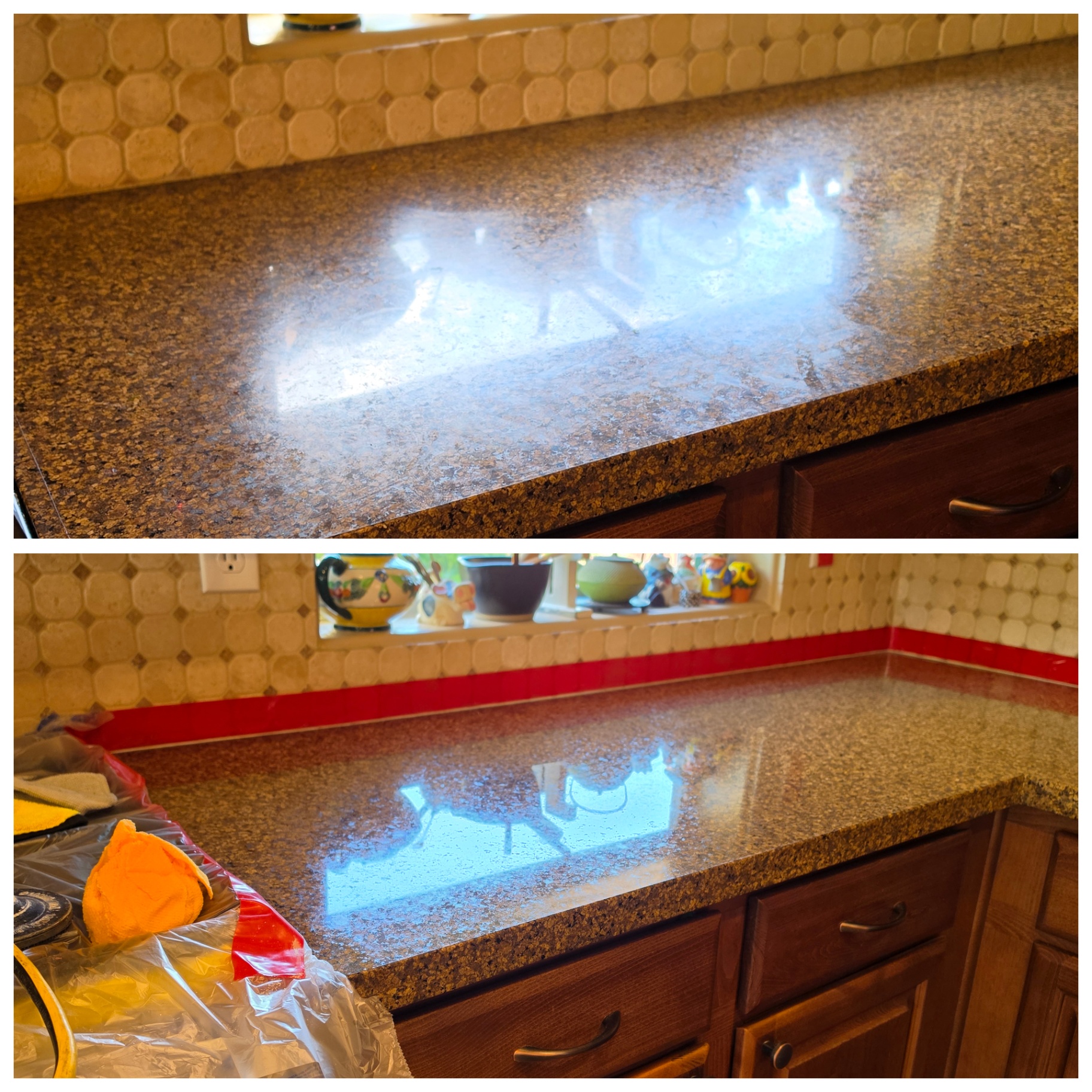
| A dry patch reflects light differently after cleaning | Finish alteration or persistent deposit | Assess before honing or polishing. |
These are possibilities, not diagnostic tests. Granite is not chemically identical to marble. Calcite-bearing stone is particularly sensitive to acids, while siliceous stone is generally more resistant but can contain vulnerable minerals. A trade name or speckled appearance is not enough to establish the exact slab composition.
Try less product, not a more abrasive pad
- Remove crumbs and grit with a soft tool.
- Use a small amount of mild compatible cleaner according to its label. Do not invent a dilution for an unidentified product.
- Rinse thoroughly with clean water and dry with a fresh soft cloth. Compare the same dry location under the same light.
- If residue clears, keep the simpler routine. If a mark persists, do not escalate to vinegar, scouring powder or a Magic Eraser.
The Natural Stone Institute notes that excess soap or cleaner can leave a film and cause streaks, and recommends thoroughly rinsing and drying. That is a more useful first response than claiming every cloudy countertop needs diamond polishing. Professional cleaning, stain treatment and finish restoration should be separately explained so you know what you are paying for.
Clean, repair, protect: choose the work the surface actually needs
Lazona Tile Care starts with identifying the material and separating removable buildup from finish damage and failed joints. Cleaning removes soil; repairs address missing or unsound grout; honing and polishing address an altered stone finish. Grout color sealing restores uniform color on suitable, prepared joints. None of these steps substitutes for correcting leaks, movement or failed shower waterproofing.
Grout color sealing comes with a 15-year warranty for homeowners. It covers the color sealer, not the tile, the installation underneath or other surfaces. Commercial work is not covered by the 15-year warranty. Grout restoration coverage through the Maintenance Plan follows the written terms. It is not a promise that stone cannot scratch or etch, or that a shower cannot leak. Review the scope before choosing protection.
For homeowners in Chandler, Gilbert, Power Ranch, Trilogy at Power Ranch and Mesa, including Las Sendas, Book A Consultation for $150. An actual test spot costs $250 and is credited toward the project total if you book. Repair work starts at a $1,500 minimum day rate, with no exclusions. These photos are not assigned to any of those neighborhoods without a verified project address.
Sources and what the photo can establish
- Natural Stone Institute: mild dishwashing detergent, excess-cleaner film, rinsing and drying
- USGS: water-hardness classification in mg/L as calcium carbonate
- The uploaded countertop collage shows differences in reflected detail. No product history, hardness sample, water-absorption timing or gloss reading was provided.