
The same acid that attacks a mineral deposit can attack marble, travertine or limestone underneath it. Vinegar is not a good routine cleaner for calcite-rich stone. Porcelain, cement grout, fixtures and stone are different materials, so judge the complete installation rather than one tile face.
One shower can contain several different cleaning risks
A shower can combine a glazed tile face, cementitious grout, natural-stone accents, metal fittings and flexible corner joints. Cleaning advice for glass alone does not establish safety for those adjacent materials. The cleaner runs downhill and collects near the drain, exactly where the stone and joints may already have visible deposits.
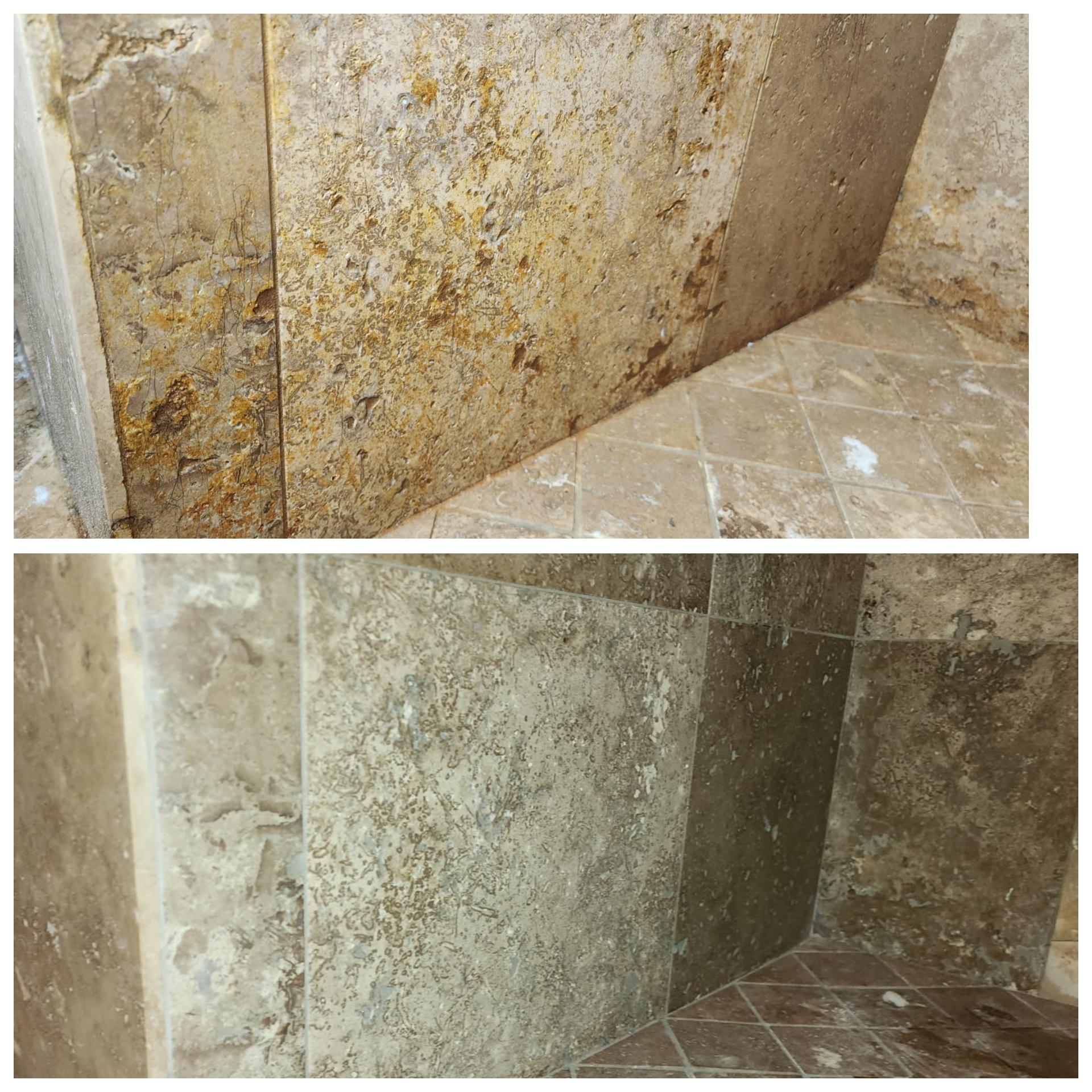
The chemistry: calcite is part of the surface, not just the scale
Marble and many limestones and travertines contain calcium carbonate, CaCO3. Acetic acid is CH3COOH. A balanced simplified reaction is CaCO3 + 2 CH3COOH → Ca(CH3COO)2 + H2O + CO2. One calcium-carbonate unit reacts with two acetic-acid units to form calcium acetate, water and carbon dioxide. This explains the material risk; it is not a countertop damage-rate calculation.
| Data or relationship | Meaning | Limit |
|---|---|---|
| 5% vinegar in the cited NSI sanitation-study description | The study names a 5% household-vinegar starting solution. | Not every vinegar bottle has this concentration; not a stone-cleaning recommendation. |
| 1 part of that vinegar plus 9 parts water | The described mixture has one tenth of the starting concentration, nominally 0.5% on the same basis. | Dilution does not establish safety for calcite stone or give a damage time. |
| 1 CaCO3 : 2 CH3COOH | Stoichiometric ratio in the simplified carbonate reaction. | No prediction of etch depth, duration or affected floor area. |
The Natural Stone Institute describes calcareous stone as mainly calcium carbonate and sensitive to acidic solutions. It recommends mild non-acidic cleaners. Siliceous stone is generally more resistant to common kitchen acids, but trace acid-sensitive minerals can still matter. “Natural stone” is not one chemistry, and “natural cleaner” is not a compatibility standard.
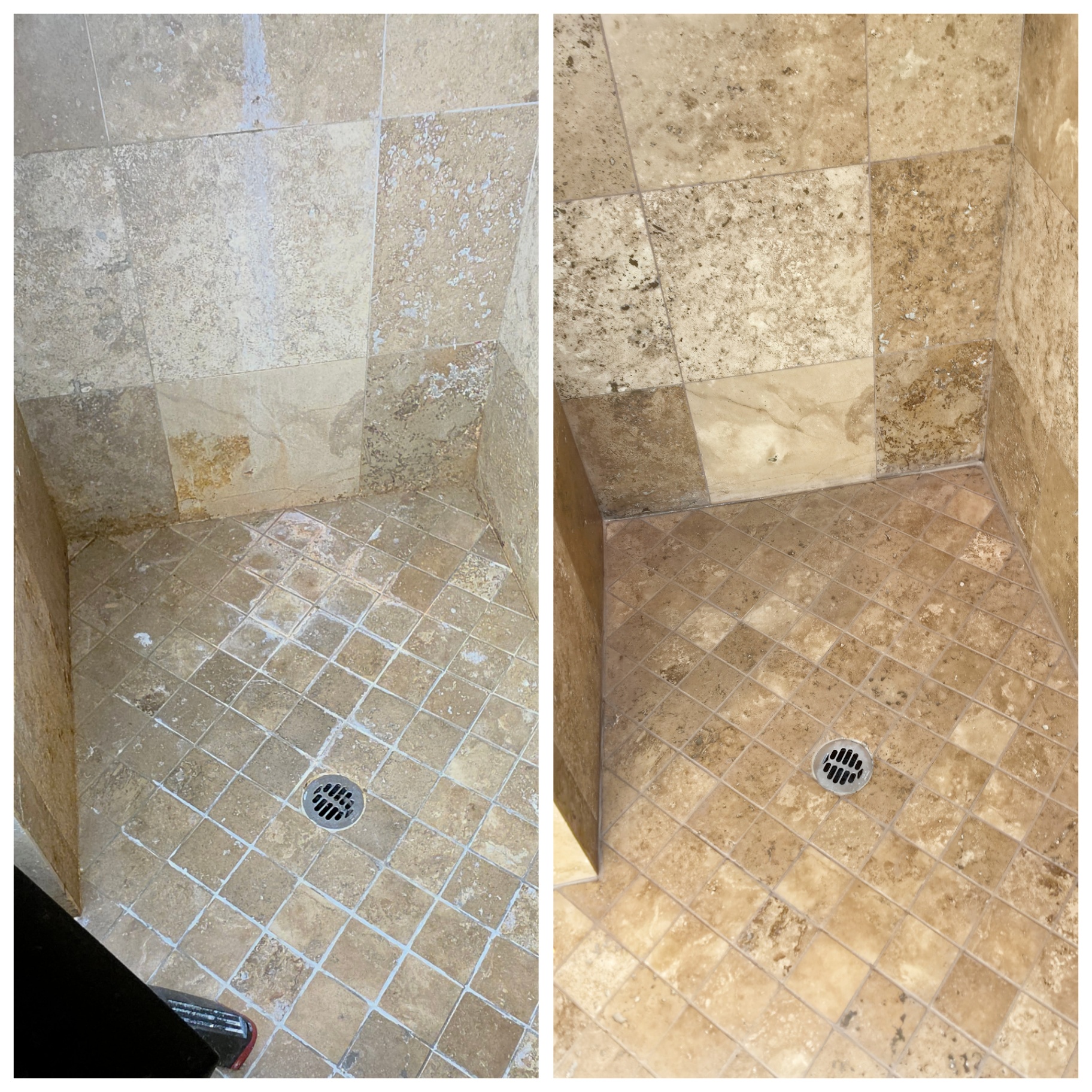
A deposit and an etch can look deceptively similar
Scale is material deposited on a surface. An etch is a change to the stone itself. Both may look pale or cloudy in a phone photograph. Removing a deposit can reveal a pre-existing etch underneath; an acidic attempt at removing scale can also alter susceptible stone. Cleaner history and an on-site assessment are needed before assigning cause.
- Polished marble: an etched patch may lose reflection clarity even when clean and dry.
- Honed stone: an altered surface may show texture or sheen differences without a mirror-finish comparison.
- Travertine: natural cavities can remain after cleaning. Visible pits alone do not prove acid damage.
- Cement grout: repeated acid exposure can attack susceptible cement compounds, but a sandy joint can also reflect installation or movement problems.
What to do after a vinegar spill
Stop the exposure, blot rather than spread the spill, and flush with clean water where the installation permits. Dry and inspect. Follow material-specific care instructions; do not attempt a home acid-and-alkali mixing experiment. If an unsafe cleaner combination has already occurred, leave the fumes and seek appropriate poison-control or emergency advice. Never combine vinegar with bleach.
Rinsing can limit further exposure, but it cannot rebuild a surface that has already etched. Nor is it accurate to claim acid keeps destroying every rinsed floor indefinitely. The actual exposure, remaining residue and material determine the result. An etched finish may need honing or polishing; a deposit may need compatible cleaning; neither diagnosis should be replaced by automatic resealing.
Choose a satin finish or a mirror finish deliberately
Honed marble and travertine can still scratch and etch. Their lower sheen may make some wear less conspicuous, but it is not chemical immunity. Polished stone offers sharper reflections and can make local finish changes more noticeable. Tile-edge flattening, void filling and finish selection are separate restoration decisions. Discuss them before assuming a cleaning service will deliver a seamless polished floor.
Clean, repair, protect: choose the work the surface actually needs
Lazona Tile Care starts with identifying the material and separating removable buildup from finish damage and failed joints. Cleaning removes soil; repairs address missing or unsound grout; honing and polishing address an altered stone finish. Grout color sealing restores uniform color on suitable, prepared joints. None of these steps substitutes for correcting leaks, movement or failed shower waterproofing.
Grout color sealing comes with a 15-year warranty for homeowners. It covers the color sealer, not the tile, the installation underneath or other surfaces. Commercial work is not covered by the 15-year warranty. Grout restoration coverage through the Maintenance Plan follows the written terms. It is not a promise that stone cannot scratch or etch, or that a shower cannot leak. Review the scope before choosing protection.
For homeowners in Chandler, Gilbert, Power Ranch, Trilogy at Power Ranch and Mesa, including Las Sendas, Book A Consultation for $150. An actual test spot costs $250 and is credited toward the project total if you book. Repair work starts at a $1,500 minimum day rate, with no exclusions. These photos are not assigned to any of those neighborhoods without a verified project address.
Sources and evidence limits
- Natural Stone Institute: calcareous versus siliceous stone and non-acidic care
- Natural Stone Institute: sanitation study and the stated vinegar mixture
- USGS: acetic-acid treatment of carbonate-bearing material
- Owner-supplied shower photographs show reduced visible deposits and discoloration. We were not given acid-exposure history, etch-depth measurements, job duration or a verified neighborhood.